
language
Picture this: a winter morning in South Australia. The temperature is in single digits. You step out of a hot shower — and reach for your towel.
If it’s cold and damp, that cosy feeling vanishes. But if it’s warm, fluffy and dry — your whole morning feels better.
This isn’t a five-star hotel luxury. A simple heated towel rail can bring that little everyday joy into your home.
Here are six reasons why more and more Australian households are making electric towel rails a must-have — from energy savings to real customer experiences.
1. Low energy consumption, high return
Many people worry that a heated towel rail will use a lot of electricity. Modern units are surprisingly energy efficient.
A standard rail operates at just 100–200 watts. Use a timer or smart plug to run it only when needed — e.g., 15–30 minutes before your shower.
Compared to running a clothes dryer for a single towel, a heated towel rail uses far less energy.
Bottom line: A tiny amount of electricity gives you warm, dry towels all year round.
2. Say goodbye to dampness and bacteria
Many coastal Australian cities (Perth, Sydney, Brisbane) experience high humidity. Towels in the bathroom can stay damp for hours — and damp towels are a breeding ground for bacteria, mould and dust mites.
Studies show heated towel rails can reduce bacteria on towels by up to 90%. When a damp towel hangs on a warm rail, the surface temperature reaches 50–60°C — hot enough to inhibit most microbial growth.
For people with sensitive skin, acne, eczema or allergies, a dry, hygienic towel means fewer irritants. For families with young children or elderly members, this is even more critical — their immune systems are more vulnerable.
Bottom line: A heated towel rail isn’t just about comfort — it’s a health investment.
3. A stylish bathroom accessory
Modern heated towel rails are no longer the bulky, industrial “radiators” of the past. Choose from minimalist vertical designs or elegant horizontal ladder styles. Finishes include matte black, brushed stainless steel, polished chrome. Some brands even offer modular designs that can be arranged into different shapes.
Whether your home is modern, industrial or light luxury, there is a style to match. Vertical heated towel rails are especially popular in Australian apartments and compact bathrooms — they use wall space instead of floor space, saving room while efficiently drying multiple towels. Add a few colour-coordinated towels and the whole bathroom feels instantly more polished.
Bottom line: A heated towel rail is both practical and decorative.
4. A small bathroom’s best friend
In Sydney, Melbourne and Brisbane apartments, bathroom space is often limited. How can you combine storage, drying and auxiliary heating in one? The heated towel rail is the answer.
It offers three functions in one: towel rack, dryer and supplementary heater. Its wall-mounted vertical design is perfect for the wall beside the shower, above the toilet, or behind the door. Each family member’s towel can hang on its own bar — ending the pile of damp, messy towels.
Compared to traditional radiators, a heated towel rail frees up valuable wall space for shelves, a mirror cabinet or a larger vanity.
Bottom line: It keeps small bathrooms tidy and organised.
5. Not just for heating towels
A heated towel rail is useful for way more than just bath towels. Here’s what you can use it for:
6. What Australian users say
Is it worth the investment?
Yes. Here’s why:
For Australian families renovating a bathroom or simply wanting a little extra comfort before winter arrives, a heated towel rail is a low-effort, high-reward upgrade.
Quick buying tips
Look for:
This winter, give your bathroom a little more warmth and a little less dampness. You deserve that small daily comfort.
FAQ
Q1: Does a heated towel rail use a lot of electricity?
A: Not at all. Modern heated towel rails are low-wattage (typically 100–200W). With a timer or smart control, energy use is minimal — far less than a clothes dryer.
Q2: Can a heated towel rail replace a bathroom heater or radiator?
A: Not completely. Its primary job is to warm and dry towels, but it does provide supplementary heating for small bathrooms. For larger spaces or rapid temperature rise, you will still need a dedicated heating system.
Q3: Do I need an electrician to install a heated towel rail?
A: Hardwired models should be installed by a licensed electrician to comply with Australian electrical safety standards (AS/NZS 3000). Some plug-in models are simpler, but if wall drilling is required, professional advice is still recommended.
Q4: Which material is best for Australian homes?
A: 304 grade stainless steel is the gold standard in Australia — rust-proof, durable and easy to clean, especially in humid or coastal areas. Mild steel is cheaper but requires regular maintenance to prevent rust.
Q5: What size should I choose? How many bars?
A: General guide:
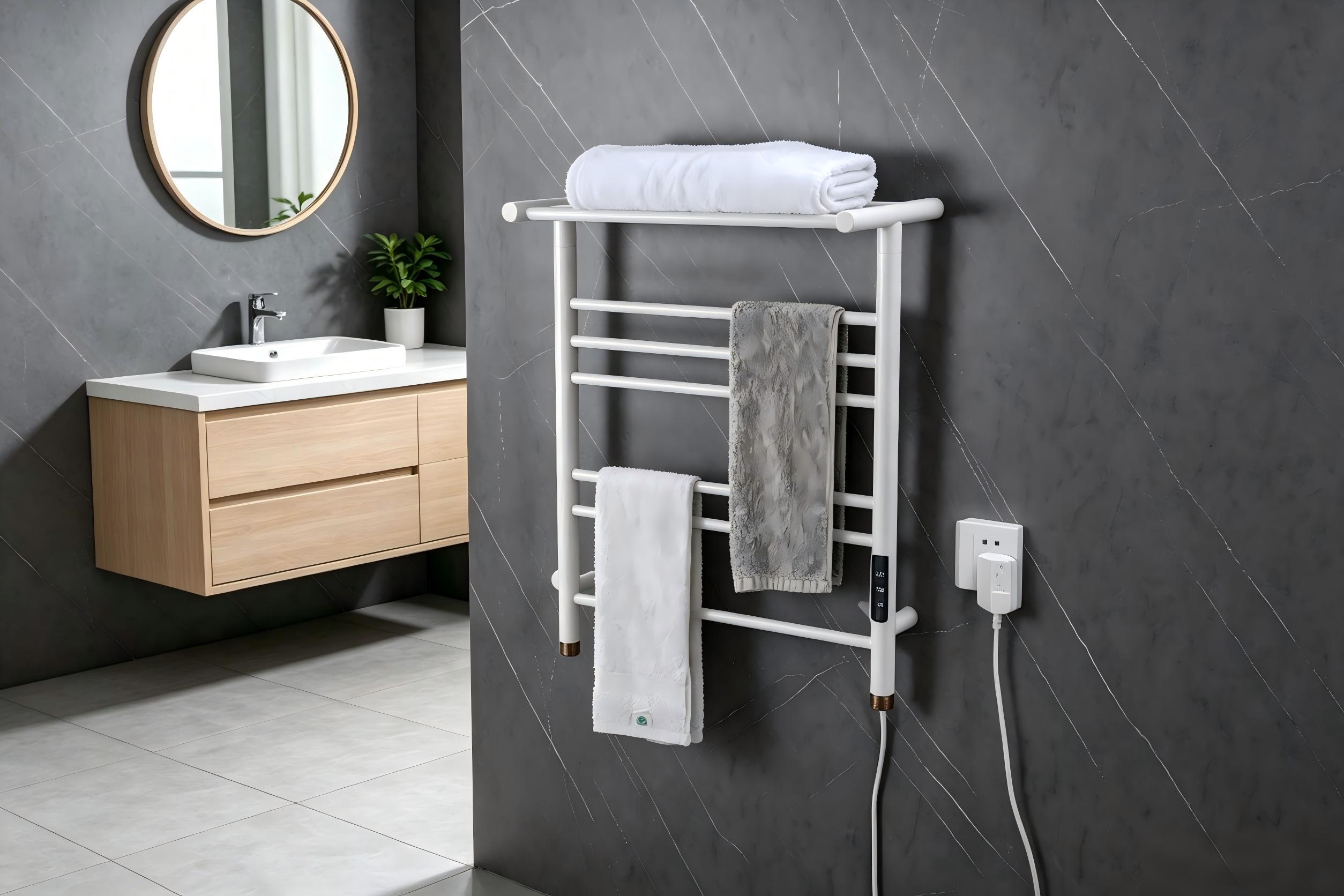
Why Every Australian Home Needs a Heated Towel Rail: 6 Compelling Reasons

